From Bakery Lab Trials to Premix Plant Production: Scale-Up Risks to Avoid
Lab dough trials are useful, but they are not a miniature version of your premix plant. A bench mixer does not reproduce ribbon blender shear, micro-ingredient carry, packaging exposure, transport vibration, or the way a commercial bakery hydrates and stresses dough.
For formulation managers, pilot bakery consultants, lab equipment suppliers, and QA service providers, the scale-up question is practical: will the premix deliver the same dough behavior in production that it showed in the lab?
When working with bulk bakery enzymes for premix manufacturers, the answer depends less on a single trial result and more on distribution, sequence, carrier choice, moisture control, and validation discipline.
Why lab success does not always scale
A lab trial usually confirms potential: volume lift, softness retention, dough tolerance, extensibility, crumb resilience, or processing stability. Plant production has a different job. It must deliver those effects repeatedly across:
- larger blend masses
- different shear and residence time
- longer exposure to ambient moisture and heat
- micro-ingredient segregation risk
- production-line dosing variability
- packaging, storage, and transport conditions
- customer bakery process variation
The enzyme system may be technically sound. The risk is often the premix environment around it.
Risk 1: assuming blend uniformity from ingredient addition alone
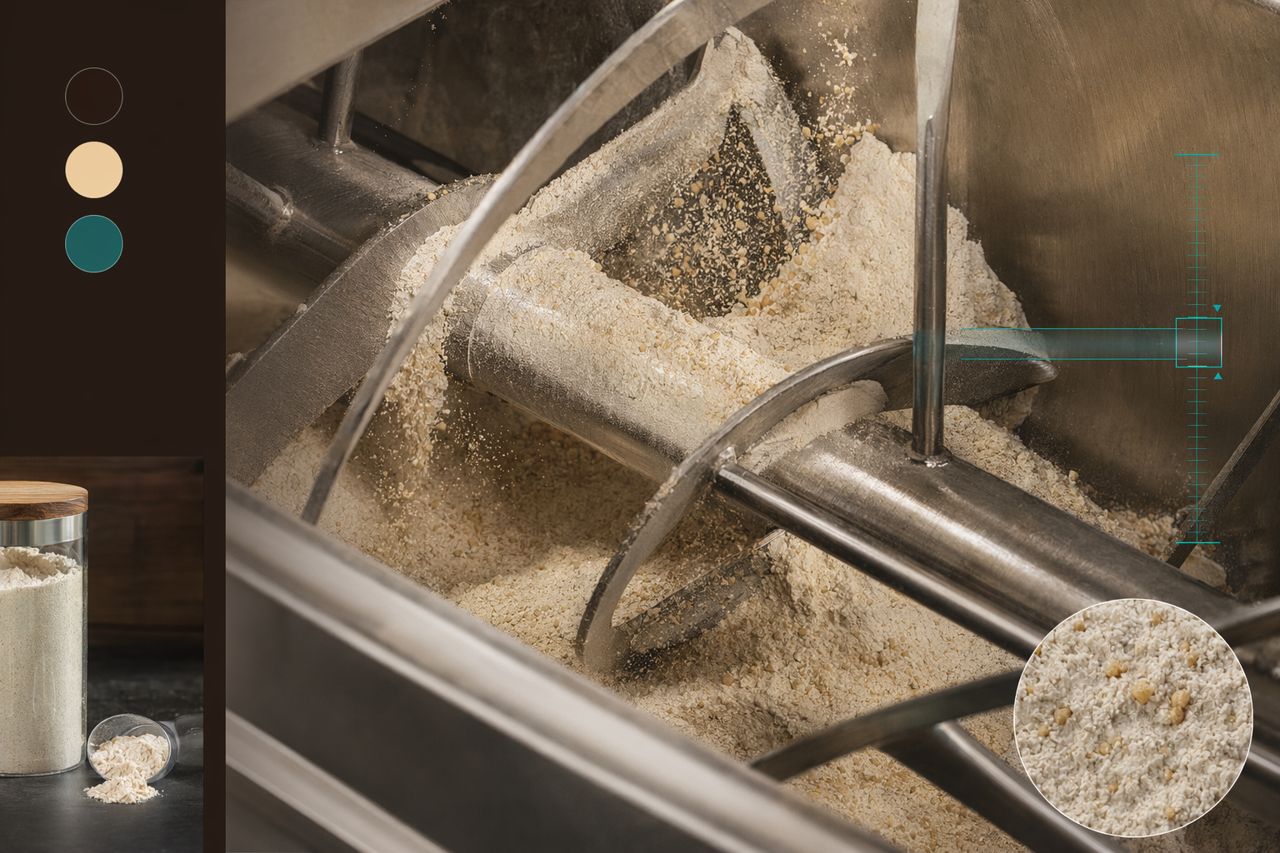
Adding an enzyme preparation to a premix does not guarantee uniform distribution. Low-inclusion ingredients can concentrate near blender dead zones, discharge points, or fines-rich layers.
Plant-floor checks to build into scale-up
- Confirm addition point relative to flour flow and other micro-ingredients.
- Review blender fill level, mixing sequence, and discharge pattern.
- Compare samples from top, middle, bottom, and early-to-late discharge.
- Watch for segregation after conveying, bagging, palletizing, or transport simulation.
- Validate repeatability across more than one batch, not only one clean run.
A reliable enzyme system should support batch consistency, not create another variable for QA to chase.
Risk 2: using a carrier that works in the lab but not in the premix plant
Carrier format affects flow, dusting, distribution, and compatibility with flour, improvers, emulsifiers, oxidants, reducing agents, minerals, and sugar systems.
A carrier that disperses well in a hand-mixed lab sample may behave differently in a production blender. It may cling to equipment surfaces, separate during discharge, or concentrate with fine particles.
What to evaluate
- visual dispersion in the premix matrix
- flow through dosing and transfer equipment
- dust control and operator handling
- compatibility with other powdered functional ingredients
- performance after normal storage and transport conditions
For bulk bakery premix manufacturing, enzyme performance begins before the dough is mixed. It begins with powder behavior.
Risk 3: misreading hydration behavior
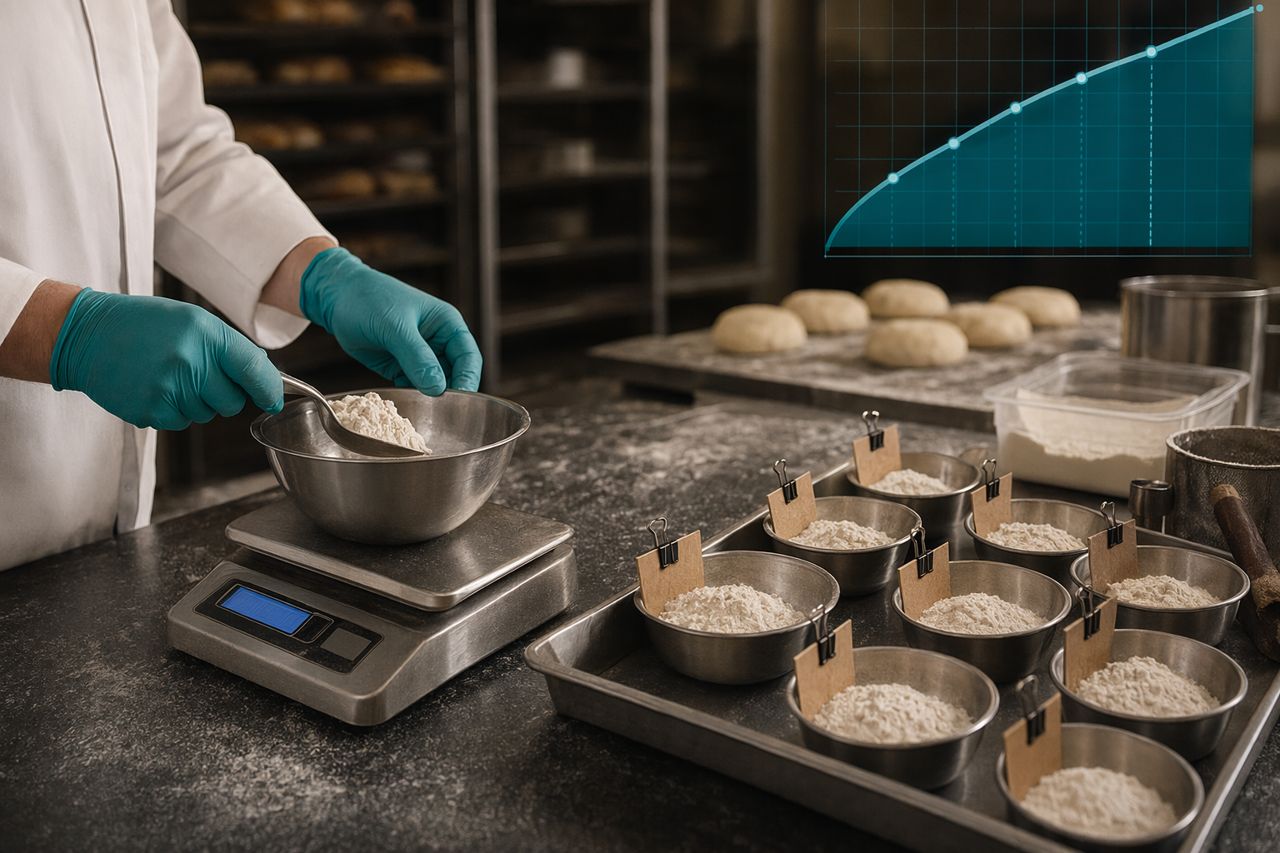
Enzymes can influence dough development, tolerance, stickiness, gas retention, and softness. But in premix scale-up, water absorption signals can be distorted by flour variation, improver package changes, particle size distribution, and test bakery conditions.
The danger is approving a formula that looks efficient in a lab bowl but gives customers a narrow water window on the line.
Better validation questions
- Does the formula tolerate realistic water variation?
- Does dough handling remain stable after normal floor time?
- Does the customer’s mixing profile change the observed effect?
- Does the premix support both fresh handling and finished product quality?
- Does the benefit hold across target flour ranges?
The goal is not a perfect lab curve. The goal is a premix that behaves predictably when the bakery is busy.
Risk 4: ignoring heat, humidity, and residence time
Premix plants are not controlled lab cabinets. Ambient conditions, pneumatic transfer, warm packaging zones, and warehouse exposure can all affect functional ingredient stability.
Enzyme selection for premix use should consider the full handling chain:
- inbound storage
- weighing and staging
- blending
- discharge and conveying
- packing
- pallet storage
- transport
- customer bakery storage
- final dough mixing
If a lab trial skips this chain, it may overstate real-world robustness.
Risk 5: scaling the enzyme package without scaling the process map
A common mistake is to approve the enzyme blend and leave the manufacturing route unchanged. In practice, the formulation and the process should be scaled together.
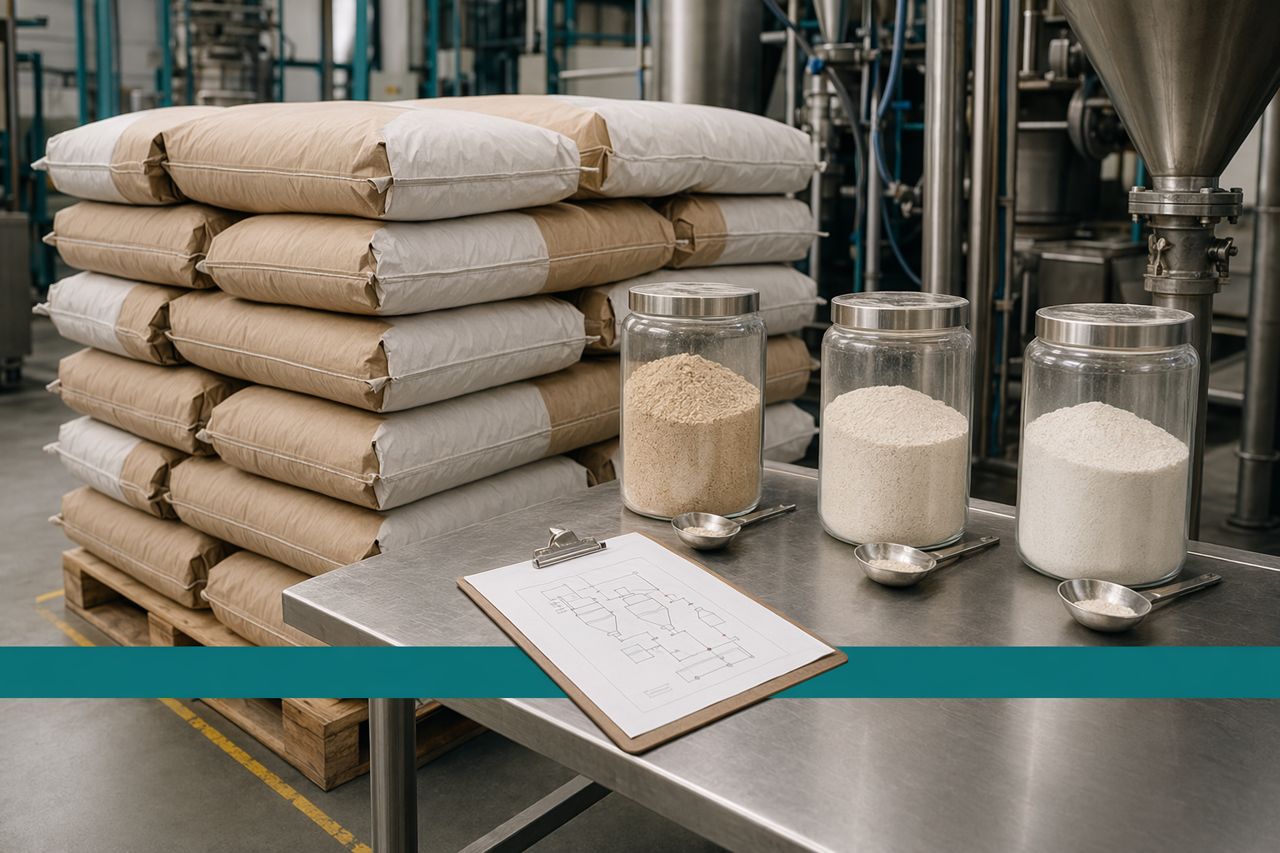
Build a simple process map
Document:
- ingredient staging order
- micro-ingredient preblend method
- addition timing
- blender loading pattern
- blend time target and acceptable range
- discharge sequence
- sampling plan
- packaging format
- hold-time assumptions
- customer application instructions
This map gives QA, production, and commercial teams one shared reference point. It also helps external pilot bakery consultants and lab equipment partners interpret trial results in plant terms.
Risk 6: validating only finished bread, not premix behavior
Finished product tests matter, but they should not be the only gate. A scale-up program should confirm both premix quality and bakery performance.
Suggested validation layers
Premix layer
- appearance and powder flow
- distribution consistency
- segregation tendency
- moisture sensitivity
- packaging compatibility
- storage behavior
Dough layer
- mixing tolerance
- water window
- extensibility and elasticity balance
- stickiness control
- floor-time stability
- machinability
Finished product layer
- loaf or bun volume
- crumb structure
- softness over shelf life
- sliceability or resilience
- product-to-product consistency
Strong scale-up connects these layers instead of treating them as separate tests.
What technical buyers should ask enzyme suppliers
When sourcing bulk bakery enzymes for premix manufacturers, technical buyers should look beyond a performance claim. Ask for support that fits production reality.
Useful questions include:
- Can the enzyme system be supplied in a carrier format suitable for dry premix blending?
- How should low-inclusion ingredients be sequenced for distribution?
- What compatibility risks should be reviewed with oxidants, emulsifiers, minerals, or reducing systems?
- What storage and packaging conditions should be protected?
- How should pilot bakery data be translated into a plant trial?
- What finished product attributes should be monitored during validation?
- Can the formulation be adjusted for different flour qualities or customer process windows?
The right answer should sound like it belongs in a premix plant, not only in a lab report.
A practical scale-up route
For most bakery premix manufacturers, a controlled route works better than a single jump from bench to full production.
1. Define the target effect
Be precise: softer crumb, improved volume, stronger tolerance, reduced stickiness, better frozen dough stability, cleaner sheeting, or more consistent customer bake performance.
2. Select the enzyme system for the application
Match the enzyme blend to the product format, flour base, process stress, and expected shelf-life target.
3. Confirm dry-blend behavior
Evaluate distribution, flow, dusting, and compatibility inside the real premix matrix.
4. Run pilot bakery validation
Test against realistic customer conditions, not only ideal lab settings.
5. Move to controlled plant trial
Use defined sampling points, retained samples, and side-by-side bake comparisons.
6. Lock the operating window
Document addition sequence, blend conditions, packaging, storage assumptions, and customer usage guidance.
Where DoughVector fits
DoughVector supports bakery premix manufacturers with enzyme systems built for dry blending, plant-scale consistency, and application-specific dough outcomes. We focus on practical formulation support: carrier suitability, blend compatibility, scale-up guidance, and finished product performance.
If your team is moving from lab trial to premix production, we can help review the risk points before the first commercial batch.
Ready to compare options for your premix line? Use the on-site request a quote form and share your product type, flour base, target dough outcome, and current production constraints.
Embedded explainer video
A short faceless explainer video is embedded on this page to summarize the lab-to-plant scale-up path: blend distribution, hydration response, process tolerance, and validation checkpoints for bakery premix manufacturers.